Wednesday, July 21, 2010

NEW DATA, NEW DATA!!!

For the past 5 weeks I quantified and analyzed previously collected data, wrote a report, and presented the findings to the board of directors. Last week, I finally collect more data, and met past College for Ama participants. It is always nice to put a face with data.

The interviewed students attended CoFA the summer of 2008. Most attend Malam Primary and Junior High School. Malam is one of most economically disadvantaged areas of Accra.

The rectangular building is school's library. The gazebo behind it is used as a spare classroom, a meeting room, a hangout spot for students, and is where I surveyed the girls.

As with most third world private schools, all students wear uniforms. Girls in dresses, boys in knee length pants, older boys must wear pants.


Access to a library in an economically disadvantaged school surprised me. As I walked around the I noticed this sign, USAID funded the building and its current supply of literature.


A University of Ashesi student, Pedal, and myself surveyed the 23 girls.We split the girls into two groups. With each of our groups we a. read the question aloud, b. explained the question, c. waited for the girls to write their answers, d. moved onto the next question.

The primary students were surveyed first, the junior high school students second. It took an hour both times to go through the survey.

Above: CoFA 2008 girls completing the survey.

To the right is Malam Primary School's Head teacher.

The entire event was organized by the head teachers of Malam School. Head teachers play an integral part of CoFA's model, they are responsible for selecting which girls should attend.

Future data collection will include teachers, and the goal is to also talk to the parents.

Monday, July 19, 2010

Lessons from John Ray

Sunday, I experience a completely different Ghanaian enclave, the African American community of Ghana. The event: a memorial service for John Ray, a 77 year old African American artist who had lived in Ghana for the past 30 or so years. The inviter: Theresa Kwekwe, a pillar in the African American community, married to a Ghanaian, and friends with my professor at the University of Michigan. I had no idea what to expect. I was told to not wear black, they were celebrating his life, and to arrive at the Debois Center around 10 am. I wore a bright yellow and orange summer dress, arrived at 10 am, and found myself surrounded by a mix of African American’s and Ghanaians, dressed in Ghanaian styled white cloth dresses. You might say, I stood out.

Finding Theresa, she politely greeted me and sent me off then told me to mix and mingle with others. The first table I introduced myself to was unfriendly and reserved; I moved on and luckily found a much friendlier table that invited me to join them. The husband was Togolese and a professor of sociology at the University of Ghana for the past 40 years; the wife, an African American researcher of women studies. They included me in all discussions, contextualized the event, and introduced me to others. Their kindness and acceptance of me integrated me in a group where I could easily have felt excluded and isolated. As time went on it was clear all the elder African Americans had played a part in the civil rights movement, vague references to the black panthers were sometimes vocalized.  Thanks to the couple I enjoyed myself thoroughly.

The event itself was unique and splendid. We sat at tables facing a stage designed to look like John Ray’s living room. Kente cloth hung on the walls, his iconic photographs hung, his sculptures displayed, but along with his art his common place loved items were shown: his plastic chairs, wooden table, bottle opener, pipe, and empty Star (beer) bottles. It was beautiful. Selected community members came forth, told a story of how John Ray touched their lives, and sat back down. Between each story a miles davis song played giving the rest of us time to talk.

The stories of John Ray evoked his spirit. The depth and breadth of his connections and the far reach of his wisdom was astounding. His nieces, a Ghanaian military peace negotiator, a chief, a Lebanese film maker, a Ghanaian beautician, a Hungarian bead maker, an African American Jazz singer, and Nina Simon’s granddaughter, all talked.  Different in occupation, age, sex, and nationality, John Ray made them think of the following things:

·         Who are you?
·         Where are you?
·         What do you stand for?
·         Focus on what you want, and forget the rest
·         Help yourself before you help others
·         Help your children before you help yourself

After the ceremony I helped clean up, and managed to meet the wife of this amazing man. We sat for an hour or so, talking about nothing important, her with a cigarette, and me with a beer. An odd day, ended well. Despite having never met him, John Ray is real to me. His pieces of wisdom, profound, silently whisper in my ear. I hope they stay there until I am also old and grey.

Who are you. Where are you. What do you stand for. Focus. Help yourself before others. Help your children before yourself.

Tuesday, July 13, 2010

Corruption in Ghana


While a place of wonderful and joyous people, in Ghana corruption is a bureaucratic norm. I have heard many stories, but knowledge and experience is different. Unprepared for the three experiences this weekend, I failed when needed the most.  

On Saturday the police stopped our taxi, asked for the driver’s license, and handed the taxi driver a folded piece of paper. The taxi driver slipped 1 cidi ($1) into the paper and placed his license on top. The policeman returned the license and waved us along. My friend asked why the driver gave a cidi.  His response, “if you give a cidi, they let you go. If you do not, they will look and look until they find a complaint. So it is better to pay.”  Passionate and furious, the driver continued into a twenty minute rant. We missed the details but understood his anger. It was all curious, interesting, but distant from us. 
Sunday: Twice the police stopped my “adopted” family and me (4 white Americans), driving a borrowed vehicle. Bribe total=60 cidis ($60).

Illegitimately stopped, the police fabricated a law stating that the dotted middle line did not indicate passing allowed for the stretch of road where we passed.  Intimidation tactics started with the opening line “we must take you to court”, and followed up with constant inputs of “we will have to arrest you”. Then a choice: arrested or meet the super intendment (and pay the unspoken bribe). My host father did speak to the super intendant, and ended up paying all the money in his pocket. He later estimated it to equal 50 cidis.

 While Steve, driving, charmed the police with his smiles and polite acquiescence, I was silently furious. No problem if left alone, but T-R-O-U-B-L-E when noticed by the police and an interested colleague. They switched off, both took their turn to lean close to the window, leered, grabbed my arm, asked me where I lived and for my number. What I should have done: smiled charmingly, talked to them, given a false number, ask for them to let us go. What I did: yanked my arm free, ignored their request for my number, did not smile, and refused to agree that they were doing us a kindness. Savior of the day: the fourteen year old girl sitting next to me. When at the end the policeman asked if he should take Steve’s money I answered “you should do what is morally correct”, she smiled and said “you should take the money and let us go or just let us go” and so we did.  Note to future self: charmingly bow in the face of police corruption.

Twenty minutes later the process repeated. Less aggressive, a legitimate concern was identified (the borrowed car’s registration had expired the day before), and it only cost us 10 cidis. 


Adaptation is one of our greatest traits as humans. With preparation, experience, and knowledge on my side, I expect myself to do better next time. Next lesson to learn: the nuance of when to bend and when it is better to take a stand. Accepting corruption cannot be best all the time, but I am glad no one spent the night in a Ghanaian prison. 

Monday, July 5, 2010

Ghana & the World Cup

Ghana was Africa’s last chance in the first African World Cup. To all past African travelers, you know how deeply embedded football is in the culture. If not, imagine boys in both dirt villages and any empty patch of land in the city, kicking around a round object. Shirts or jerseys are used to mark the goalposts. They run in the heat, often without shoes, and happily go at it. Despite this almost continent-wide love for football, no African nation has made it to the quarter-finals of the World Cup before. On Friday night, Ghana had a chance to do so. 

Accra hummed with excitement. For the past week, since Ghana’s defeat of the US, locals have dressed in completely Ghanaian colors. By game day, skirts were created with two flags sewn together, flag scarves were wrapped around heads, jersey shirts with the names “appiah” “muntari” and an increasing number of “gyan” covered torso’s all over the street. 

I live a block away from downtown Accra, and I was excited to take my roommate and her colleague to “Oxford” street to watch the game. Our actual location was at a local tilapia restaurant. When I say a restaurant, I mean a set of outside plastic tables covered with plastic sheets. The game is projected onto the white section of the apartment complex’s wall. You have to wait for dark, 10 minutes before the game starts at 6:30 pm before the game is visible. 

The food at this simple restaurant is splendid. Fresh tilapia, marinated, slowly grilled for 30 minutes, and served with fresh vegetables and banku. All is eaten with the right hand, fingers actively skin, and debone the fish, all of it then wrapped in the banku (a fermented starch) and the veggies. 

The game itself was the most suspenseful I have ever watched. Ghana and Uruguay were evenly matched for most of the first half. In the last minute before the half time, Ghana scored. The restaurant erupted. The waitresses, waiters, our table neighbors, and the people watching from the staircase ran all around, screaming, waving anything with Ghana colors. 

People ran up to strangers and hugged each other in shared jubilation.
Well, from here, you must know the rest. Uruguay scored in the second half. In the last minute of overtime, Ghana’s winning goal was blocked by the hand of a defender, not the goalie. So with less than a minute to go, Ghana was awarded a penalty kick. Gyan against the goalie, it seemed we must win. We held our breath, leaned toward the screen,  and watched the ball hit the pole and bounce out. Ghana missed its penalty goal, and the 30 minutes of overtime were over. In the penalty shots, where five strikers from each team get to shoot towards the goal, we lost. Uruguay missed once, Ghana twice. 

The silence was deafening. Sadness, disbelief, and rage smothered the air. Its pressing weight seemed to squeeze out the oxygen. Walking home, heads were bent, and occasional swear words, another calling out, “don’t be sad, It’s okay .”The whole weekend was surprisingly quiet in Accra.

Over the next few days, some people criticized the Ghanaian player, others Fifa, and Uruguay for citing the hand block by a non-goalie as the source of ghana’s failure. My favorite response came from a Ghanaian I met on Saturday. He said those who criticize are not grateful. Ghana played well, and we can be proud. There was no one mistake; every shot or chance we missed was a mistake. It was a game, and we played well. We should be proud. In the next world cup, watch Ghana. We will play and advance farther next time. 

On those words of wisdom, I will leave you. Below are some pictures of Friday night. Sorry I didn’t get a picture of oxford street! I was worried about pickpockets. 

Ready for the Game!: Ghanaian Trader Woman (Left), Roommate Suzanne & Me (Center)


Duncan's: Apartment Complex (right), White wall TV projected onto (center), friends & food (left)


Monday, June 28, 2010

Pictures from the Eastern Region


Hi Everyone,

Hope all is well. Today I am entering data while trying to download Norton and Windows. My computer problems have been multiple, but they should all be fixed soon (if only the downloading process hurries up!)  I have blog posts completed, but I cannot post them until the downloads are complete. So this is a check-in entry

I work for a very small non-profit. I do not have an office, but I have access to the resources of our biggest funder Ashesi University. Currently, I have no pictures of my work, mostly because I'm quantifying past surveys to create a baseline of how my nonprofit affects its beneficiaries and I'm researching policy. I have more to say on that in one of the posts I'll paste later.

 I do have some pictures of Ghana. This weekend I visited the Eastern Region. I have made friends with some Peace Corps people, who are great travel companions! I love getting out of Accra as the people are far friendlier, and lifestyles more interesting. So here is a study of a small bit of Ghanaian Life.


This is one of the market streets of Kofaridua, a major city in the Eastern Region of Ghana. The large white bucket on the table is holding large fried fish. They are gross to look at the first time, but over time you get used to them. The pigs' feet take a little longer to get used to!
This is one of my favorite sources of street food. The women walk with this tray of boiled eggs on their heads. In Accra, it cost me about 50 pewas (cents) for one boiled egg. The egg will be deshelled in front of your eyes, cut in half, placed on a small plastic square and one tablespoon of the spicy salsa is placed a the center. Yum!


Here is a picture of the tro-tros. This is at the Medina Station, one of the major stations to grab a tro before one sets to go off to another part of Ghana. My trip was only 2 hours long, so I traveled by tro instead of the nice STC buses that are used for the 15-hour rides across the country.


This is what the inside of a tro-tro looks like. Garbed in black signals the women to the left are going/returning from a funeral, any traditional garb in black and red cloth is also only worn for funerals. 


Kofuridua (I'm sure to be spelling it wrong) is famous for its bead-making factory and bead market. This stand displays beads from all over western Africa, new and old styles. On arrival in Ghana, I kept looking for wooden carvings, stone statues, or paintings to be sold by the road like they were in Zimbabwe and Burkina in my childhood. They were absent. When I asked my Ghanaian boss about it she said "Natalie, in Ghana we do waste our time with impractical art. We have art that is useful. Look at our fabrics, look at our beads, this is Ghana art". I think this economizing of beauty says something about Ghana and how they value their time.  If something is done, it is done with a purpose. I like to think of this statement when I get frustrated with the turtle-paced speed of Ghana. 

The traditional houses in Ghana are very different between different peoples and regions. This is a traditional village mud house in Eastern Region's wet forest. I stayed the night with a peace corp couple who are serving this small village. Apparently, these houses provide good ventilation, which is extremely useful considering Ghana's extreme heat and lack of electricity.


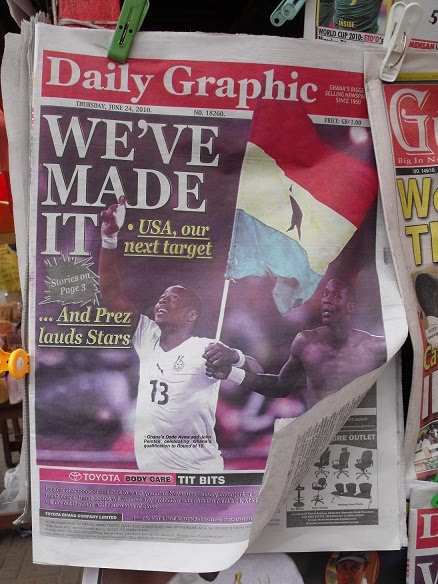
This is before the USA vs. Ghana game, but right after Ghana vs. Germany game. Despite Ghana's loss, we made it to the next round. All across Ghana people proclaimed Ghana's Victory saying "Ghana is Advancing". In both Accra and the Eastern Region vuvuzela's randomly trumpeted, celebrating the success. As Africa's last home in the first African-hosted world cup, Ghana is proud to be the star of Africa! Despite this, I did cheer for the US in the last game, though I was not too heartbroken when we lost. Go Ghana! 

Wednesday, June 9, 2010

Going to Church

Yes, believe it or not, I went to Church on Sunday. My professor at U of M warned me that I might have to go to church, and she was right (especially as my roommate is the wife of a minister). It was a positive experience.

Things I liked about this Church included it had both Ghanaian and ex-pats, so it did not feel segregated in any way. Also, my roommate chose this Church over the one that is completely ex-pat as it is far less conservative and has a better band. The band had two electric guitars, 1 western drum set, a saxophone, and then the main singer had a phenomenal range. Mel, you'd have been impressed. Then there were about 6 young women and one young man who all sang as well, not as beautifully but definitely still enjoyable. 

The Methodists are interesting as they rotate ministers and have one pastor. I think it's all very democratic. There were multiple small readings from the bible and one longer sermon. It was a longer service for me but short for Ghana, as it was only 1.5 hours long instead of 3-4. I started checking the time after the first 30 minutes as that's when the band stopped playing and the sermon's started. 

As for content, I was hoping the minister would speak of ethics or philosophy. To question what is right and wrong, and then how to best rationalize the best answers. This was not so, as the sermon was mostly about faith and the need to sacrifice to demonstrate one's faith. The content, as promised by my roommate, was not too controversial. The only line I had a problem with was when the pastor said no one should be ashamed of their faith, "especially we Christians ." I was sensitive to the fact it puts other religions in a slightly pejorative stance. But to be fair, as far as controversy goes, this statement was quite mild. Especially when I compare it to political associations in the US; at home, the party line must all conform! So I suppose I should not fault the pastor.

I may go to Church again; we shall see.

Speaking to be Understood

Speaking to be Understood

Being a child of nomads, being an expat generally means you have to learn how to talk to be understood. Accents are strange and transient things, yet for non-nomadic people, they are expected to be constant indicators of where you are from and sometimes even your class, education level, and culture. People react surprisingly strongly to them, especially if your accent is different from what they expect. 

Going to a colonial-British elementary and middle school and having an American parent and an Italian father (who I am told has a very strong accent), all left me with a very different accent by the time I arrived in the US at the age 14. In one year, I trained myself to speak "American. "When I studied abroad in South Africa, I wrongly thought I would need to change my accent to be understood. But Western Cape South Africans, who are the most Westernized of all South Africans, were offended by the accent change as were the other Americans in the group. I learned very quickly not to switch. Two years later, I worked in the Free State of South Africa, where my accent was a barrier to being understood. I was resistant to changing my accent, having been burned last time. 

In Accra, I have accepted the need to change my accent a bit if I want to ride public transportation. I am having to dig out a bit of my old accent in Zimbabwe and am developing new sounds as well. The current changes include a slower speaking pace and how I say the letter A. The word “mall” is a deeper sound that feels like I am trying to create enough space in my mouth to fit a potato. For the word “water” is not said at all like I did in Zimbabwe, but rather is a very strange mix of sounds. The first syllable “wa,” sounds like how you say wat in the dish dorowat, or I guess it sounds like “waaat” but said very quickly. The second half of the word slows down and you pronounce “ter” like Americans pronounce the word “turd” but without the letter d. 

In Ghana, the ex-pat community that I have met so far seems to speak with an American accent and accordingly, around Americans, I change it. I know that for some of my fellow Americans, this switch is castigated as condescending. But, in all honesty, it is the craft of being spoken to be understood.